We love announcements like this! We’ll be meeting you at the VMware FutureTech Forum on September 25.
Remember the keynote by Marcin Rzepa, who will explore the secrets of VVF and VCF. He will talk about implementing VCF with VMware Aria:
👉 Speed of troubleshooting with advanced diagnostics, 👉 Comprehensive visibility into the world of applications, IT infrastructure and VCF along with automation in a VCF environment, 👉 Shows you how to look inside the application and see what it is related to and what the failure is due to, 👉 Will present performance and cost optimization.
Looking for something exciting to do on September 25, 2024? We’ve got something for you! We invite you to the VMware FutureTech Forum where Marcin Rzepa will be sharing insights into the world of VVF and VCF.
See you at the event! – West Gate Warsaw, Al. Jerozolimskie 92.
During the session, you’ll discover how to enhance your private cloud environment using VMware Aria as part of the VCF solution, integrated with advanced fault diagnostics and data center inventory management.
We’ll cover real-world use cases, showcasing innovative implementations that provide comprehensive visibility and event-driven automation. Covering the full VCF stack—including hardware, applications, and business services—we break down IT technology silos. This helps teams embrace a #DevOps culture, where they can predict potential failures, reduce detection time, and automatically respond to incidents by optimizing performance, gaining cost insights, and executing predefined actions.
In our presentation, we will discuss: Innovative VCF deployments with VMware Aria, Faster problem resolution through advanced diagnostics, Comprehensive visibility into applications, IT infrastructure, and VCF with automation in the VCF environment ,How to dive into applications to understand their dependencies and root causes of failures, Performance and cost optimization.
Join us to discover firsthand how these integrated solutions can revolutionize your IT infrastructure, boosting reliability, maximizing efficiency, and driving cost savings.
At INDEVOPS, we always support people with passions, and even more so in sports, since sports at our place interest almost everyone. We have a group on the #Strava app that regularly trains in various sports and records their results. Healthy competition helps us to achieve not only private, sports, but also professional goals. Active recreation is always on top, and we stick to that.
In this holiday time, we want to remind you of the story of our colleague Szymon Leszega, because he is preparing another sports surprise for us and you. We will write about it soon, in the meantime we wish you a good vacation and invite you to read the article.
Why Didn’t I Know About This Sooner? Aria and Its Unique Features
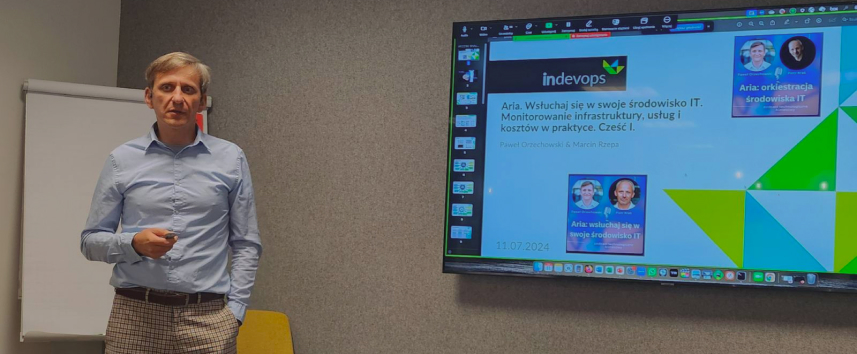
At INDEVOPS, we aim high but keep our feet on the ground. We’ve been specializing in the Aria Suite, particularly Aria Operations, for nearly 7 years. And for those 7 years, when we’ve talked about how fantastic this tool is and how unique its capabilities are, every time our listeners’ eyes widen in amazement: “Why didn’t I know about this sooner?”.
Let me remind you that Aria Operations, commonly referred to by us as #AROPS, is a tool for analytics in monitoring (#AIOPS, or #MLOps), for comprehensive monitoring, performance management, and optimization of IT environments in data centers. AROPS, together with Aria Operations for Logs and plugins and agents, allows you to collect from everything you can imagine, from a rack cabinet in a data center to the inside of an application (yes, yes, that’s also possible).
At the beginning of their journey with Aria, customers have difficulty fully understanding its potential uses. We have our own way of configuring it to enable success in the shortest possible time, so our story about how we do it is different from VMware’s.
How do we present the collected information and what does it mean?
The key is to divide the entire IT stack into layers: data center, servers, networking, #storage, #middleware, applications, and access.
We present the layers as “health” circles, as well as heatmaps of objects that allow you to quickly determine their state.
The layers are divided into business services so that business owners and operators only see their own service.
What do we put in each “circle”?
A “circle” is a group of objects that make up a given layer or business service.
The “circle” has a “%” – expressing the health of all the objects inside it.
In this way, we know whether a business service or service layer, or an entire layer in the data center is.
Here’s a separate story about business services:
because universal metrics allow them to be effectively monitored immediately,
there is no need to calculate complicated SLAs,
it is easy to identify the components of a business service.
How do we tune alarms, which reduces their number by 45% at the start?
Thanks to our experience, we have a ready-made recipe to prevent you from being flooded with alarms and notifications.
We won’t give you a ready-made recipe here.
We treat each case individually.
And then all the “little things”:
How do we configure monitoring robots?
How do we monitor services?
How do we query application portals from outside?
How do we check certificates and much more?
How do we use agents optimally?
Lately, the presentation of automation combined with monitoring has been a hit:
How to trigger automatic actions when the disk is full?
How to collect reports from domain systems into one place?
It’s great because our presentations are lively and customers ask specific questions, they know what they are looking for and what matters to them, e.g.:
What else can I connect to monitor?
How do the metrics work?
How to build a clear and functional #dashboard?
In answering these and other questions, and at every stage of such a conversation, we support ourselves with real-life examples. This is very important because then the customer has a chance to imagine and place every detail.
The icing on the cake is always a story about our own management and content packs. Yes, yes, we write our own management packs (more on that soon ).
At the end, the potential customer is left with their mouth open.
For the most curious ones, we can provide documentation.
And for the biggest skeptics, we have a reference visit.
Everything you need to make a customer happy.
Write to us about Aria Operations and other topics related to analytics in monitoring, orchestration and automation.
Do you want to implement it in your environment, or do you want to monitor a specific element in your data center? Let us know.
This text was inspired by a visit to a client and a note taken by our engineer. Unfortunately, I won’t write which one, because the sensitivity of this information does not allow it. This visit, the first in a long time to a new potential customer, who was left with his mouth open.